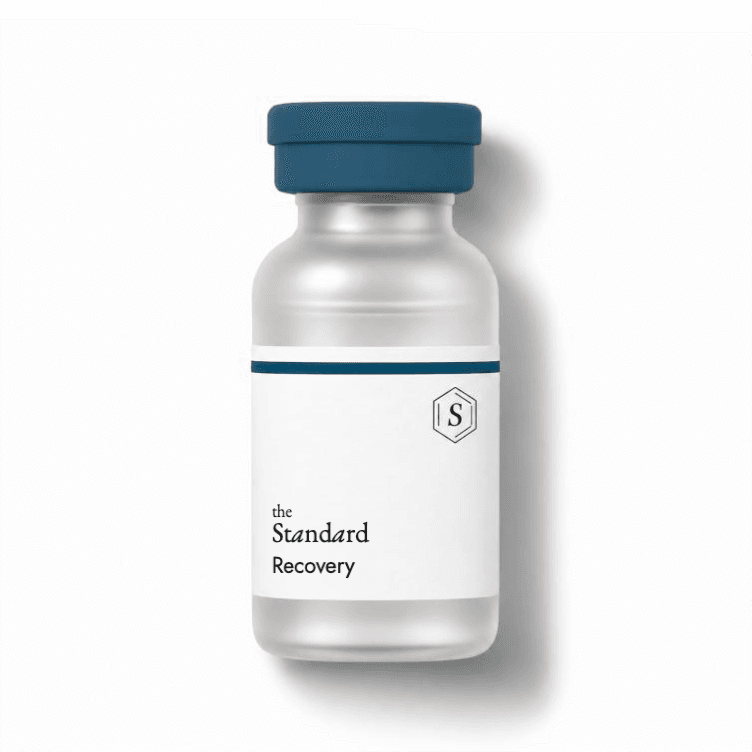
TB-500.
Training hard takes a toll on soft tissue. TB-500 is a 7-amino-acid thymosin beta-4 peptide in preclinical research on tendons, ligaments, and wound models.
- TendonsPreclinical research
- Skin woundsPreclinical research
- Thymosin beta-4 in peoplePreclinical research
$149 first month regular price $189/mo
Ships to all 50 states and Washington, DC.
What TB-500 is studied for.
After Achilles tendon surgery, rats given TB-500 had tendons that held more load, and better tissue scores, than untreated rats. The paper didn’t confirm which molecule its TB-500 contained.
A gel of the same 7-amino-acid stretch, without TB-500’s acetyl group, helped skin wounds close in aged mice. In a lab wound test, intact TB-500 didn’t speed closure, but one of the pieces it breaks down into did.
Full-length thymosin beta-4, the protein TB-500 is taken from, has been given to people as eye drops, a skin gel and IV infusions. IV doses up to 1,260 mg caused only mild to moderate side effects.
What comes with every prescription.
Reviews your health history and medicines, and tailors your prescription when appropriate.
Compounds it to order for your individual prescription after your provider writes it.
The active ingredient comes from an FDA-registered manufacturer, as HHS’s policy requires.
The monthly price covers your provider review, the medicine, and shipping. Cancel anytime.
What TB-500 is.
TB-500 is a chain of 7 amino acids with an acetyl group on one end. It copies the stretch of thymosin beta-4, a protein in most of the body’s cells, that binds actin, a building block of the cell’s internal skeleton. This TB-500 is made in a lab.
A small injection under the skin. Your provider sets the dose and schedule.
One 5 mL vial at 3 mg/mL (15 mg in all), compounded by a state-licensed 503A pharmacy for your prescription.
Ac-Leu-Lys-Lys-Thr-Glu-Thr-Gln
What the research shows.
Not FDA-approved for any use. TB-500 has never been tested in a human trial. Most research is on thymosin beta-4, the larger protein it comes from, and those results may not apply to TB-500.
TB-500 matches 7 of thymosin beta-4’s 43 amino acids. FDA’s 2026 review found no human data on TB-500 by any route. Full-length thymosin beta-4 has been tested in people, as eye drops, a skin gel and IV infusions, but it’s a different molecule, and products sold as TB-500 have often turned out to contain something else.
- 01ANIMALDiabetic and aged mice
A gel of the same 7-amino-acid stretch, without the acetyl group, helped skin wounds close in aged mice about as well as full thymosin beta-4.
Philp et al., Wound Repair and Regeneration, 2003 - 02LABHuman serum and skin cells in a dish, and rats
In a lab wound test, intact TB-500 didn’t speed wound closure. One of the pieces it breaks down into did.
Rahaman et al., Journal of Chromatography B, 2024 - 03ANIMAL32 rats after Achilles tendon repair, from another research group
Rats given TB-500 had tendons that held more load and better tissue scores than untreated rats. The paper didn’t confirm which molecule its TB-500 contained.
Biçer et al., Joint Diseases and Related Surgery, 2026 - 04ANIMALHorses, one 10 mg dose
A doping-test study. After one dose under the skin, blood levels peaked at 1 to 2 hours and couldn’t be measured by 6 to 10 hours.
Ho et al., Journal of Chromatography A, 2012 - 05HUMAN40 healthy adults; full-length thymosin beta-4, not TB-500
IV thymosin beta-4 at doses up to 1,260 mg, and daily for 14 days, caused only mild to moderate side effects, and none limited the dose.
Ruff et al., Annals of the New York Academy of Sciences, 2010 - 06REVIEWReview for orthopaedic surgeons
TB-500 is often wrongly treated as the same as thymosin beta-4. There are no validated dosing, blood-level or long-term safety data, and the authors recommend against routine use.
Tham et al., Journal of the American Academy of Orthopaedic Surgeons, 2026
Most of this research is in animals, and study results aren’t a promise of results for you.
HHS’s policy for six compounds
On October 30, 2026, HHS published a policy that lets state-licensed 503A pharmacies compound TB-500 and five others for a patient’s prescription, under conditions. It is not FDA approval, and HHS can change or withdraw it.
Read the notice in the Federal Register- 01One ingredient per product
The policy covers each compound on its own. Blends of two or more aren’t covered, so we don’t sell them.
- 02A state-licensed 503A pharmacy
It’s compounded for one patient’s prescription, after the prescription is written.
- 03An FDA-registered source
The pharmacy has to make it from an active ingredient produced by an FDA-registered manufacturer.
- 04A prescription written for you
A licensed medical provider evaluates your health history and prescribes it only when appropriate.
- 05Allowed routes for TB-500
Injection under the skin or into a muscle
Before you start.
- ×Pregnancy, planned pregnancy, or breastfeeding
- ×Active cancer, or a history of cancer
- ×Under 18
- ×Known allergy to TB-500, thymosin beta-4 or any ingredient in the vial
- ·Redness, itching or swelling where you inject
- ·Rarely, an allergic reaction: get emergency care for trouble breathing or swelling of the face or throat
- ·Otherwise not known: there are no human safety studies of TB-500
- ·Any history of cancer
- ·Blood thinners, or medicine that suppresses the immune system
- ·Allergies, or past reactions to injections
TB-500 is named on the WADA Prohibited List (S2, as a derivative of thymosin beta-4) and is banned at all times, in and out of competition. If you compete in tested sport, it isn’t for you.
How it works.
See your exact price upfront with zero membership fees, then share your health history online.
A licensed U.S. medical provider reviews your answers and writes a personalized prescription when appropriate.
A state-licensed 503A pharmacy prepares your prescription from an FDA-registered active ingredient source.
Shipping estimates begin after your prescription is compounded and dispensed, not at checkout.
Common questions.
Is TB-500 FDA-approved?
No. TB-500 isn’t approved for any use, in the US or anywhere else. State-licensed 503A pharmacies can compound it under HHS’s policy of October 30, 2026, and that policy is not an approval.
What do people use TB-500 for?
Mostly recovery from training and soft-tissue strains: tendons, ligaments and muscle. That interest comes from studies of thymosin beta-4, the larger protein it’s taken from, and a few animal studies of TB-500 itself. Your provider decides whether it fits your goals.
Is TB-500 the same as thymosin beta-4?
No. TB-500 is 7 of thymosin beta-4’s 43 amino acids, with an acetyl group added. Most published research used full thymosin beta-4, so it may not apply to TB-500.
How is TB-500 different from BPC-157?
They’re different molecules. TB-500 is 7 amino acids taken from thymosin beta-4, a protein cells use to move. BPC-157 is 15 amino acids based on a stomach protein, studied mostly in rat tendon and gut models. In one rat study after tendon surgery, TB-500 did better on strength tests than BPC-157, and the two together added nothing.
Can I take it with BPC-157?
Only as two separate prescriptions, and only if your provider decides both are appropriate. HHS’s policy covers one ingredient per product, so we don’t sell blends.
Who decides if I get it?
A licensed medical provider reviews your answers and health history, and prescribes it when it’s appropriate for you.
Why get it through a prescription?
So you know who reviewed your health history and who compounded your vial. A licensed U.S. medical provider checks your health history and medicines first, and a state-licensed 503A pharmacy compounds it to order from an active ingredient made by an FDA-registered manufacturer.
What does the monthly price include?
Your consultation, one 5 mL vial compounded for your prescription, shipping, and refills to your prescription. You see the total before you pay.
Where do you ship?
All 50 states and Washington, DC.
The other four.
Payment is collected before clinical review. You’ll see the total due today before you pay. No refunds or returns once your prescription goes to the pharmacy.
Compounded drugs are not FDA-approved. FDA does not review compounded drugs for safety, effectiveness, or quality. Not a generic version of any brand-name drug. Rx only. A licensed medical provider decides whether it’s appropriate for you.